
Description
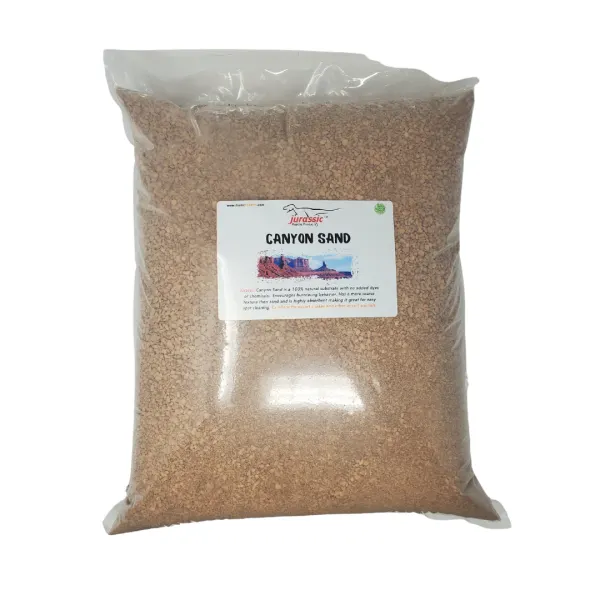
Jurassic Canyon Sand, slightly reddish, creates a natural desert setting.
Jurassic Canyon Sand is a 100% natural substrate with no added dyes or chemicals.
Canyon Sand —
A fine, mineral-rich sand often used in horticulture can be a game-changer for improving soil structure and supporting specific plant types.
Here’s how it benefits your garden and which plants thrive with it:
 Benefits of Canyon Sand in Gardening
• Improves Drainage: Canyon Sand helps loosen heavy clay soils, allowing water to flow more freely and preventing root rot.
• Enhances Aeration: Its gritty texture creates air pockets in the soil, promoting oxygen access for roots.
• Supports Root Development: Especially helpful for young plants and cuttings that need loose, well-draining media.
• Balances Soil Texture: When blended with compost or loam, it creates a more stable growing medium for sensitive plants.
• Reduces Compaction: Ideal for raised beds or areas with foot traffic, keeping soil light and workable.
 Plants That Benefit from Canyon Sand
 Succulents & Cacti
• Thrive in fast-draining soil
• Canyon Sand mimics their native arid environments
 Mediterranean Herbs
• Lavender, rosemary, thyme, oregano
• Prefer sandy, well-drained soil with low fertility
 Root Crops
• Carrots, parsnips, radishes
• Need loose soil to grow straight and deep
 Seedlings & Cuttings
• Mixed into seed-starting blends to prevent damping-off
• Promotes gentle drainage and root aeration
 Native & Drought-Tolerant Plants
• Prairie grasses, echinacea, yarrow
• Adapted to sandy or rocky soils
Jurassic Canyon Sand can also be used as a sub-layer or watertable in bioactive setups, to collect water in the bottom of high humidity terrariums, separated by a barrier (Jurassic biocarpet) from the soil/substrate above (e.g. Jurassic ABG Frog/Terrarium Mix, or Jurassic Coco Fiber).
The increased surface area of Jurassic Canyon Sand facilitates bacterial growth to biodegrade nitrogen/waste, and aids in water filtration.
Jurassic Canyon Sand can also be used to create a bottom layer in terrariums with standing or running water, such as a waterfall setting.
Canyon Sand can be quite useful for both plants and animals:
For Plants:
- It can be used as a soil amendment to improve drainage, especially for succulents and cacti.
- It adds a natural aesthetic when used as a top layer in gardens or pots.
- It can also be used in terrariums to create a desert-like environment for certain plant species.
For Animals:
- It’s often used in enclosures for reptiles, such as lizards and snakes, to mimic their natural habitat.
- It can provide a comfortable substrate for burrowing animals.
- In aquariums, it can serve as a substrate for fish that thrive in sandy environments.


